Enabling Agent-Assisted Applications for Ladder
Unlocking a scalable IMO channel through agent control, faster closes, and higher-quality conversion.
I designed Ladder's first agent-assisted application experience to unlock IMO distribution, enabling agents to start applications and seamlessly pass them to clients for review and submission. This closed a critical gap where agents had no control or visibility after sharing a quote, transforming how Ladder works with IMO partners. The solution achieved 26.9% end-to-end conversion, meaning roughly 1 in 4 agent-assisted clients bind a policy, and established a reliable, month-over-month revenue stream that scales with partner growth.
Introduction
Agents remain central to how most people purchase life insurance, and are critical to Ladder's long-term growth strategy.
Prosperity, a life insurance carrier, partnered with Ladder to distribute Prosperity-backed term products through their IMO channel, with Ladder serving as the front-facing application experience for agents and clients.
I led the design of Ladder's agent-assisted experience, enabling IMO distribution through agent-led applications and pass-the-application flows that allow clients to review and submit with confidence.
This case study focuses on the agent-assisted application flow, the core unlock for scaling Ladder through the IMO channel.
The Problem
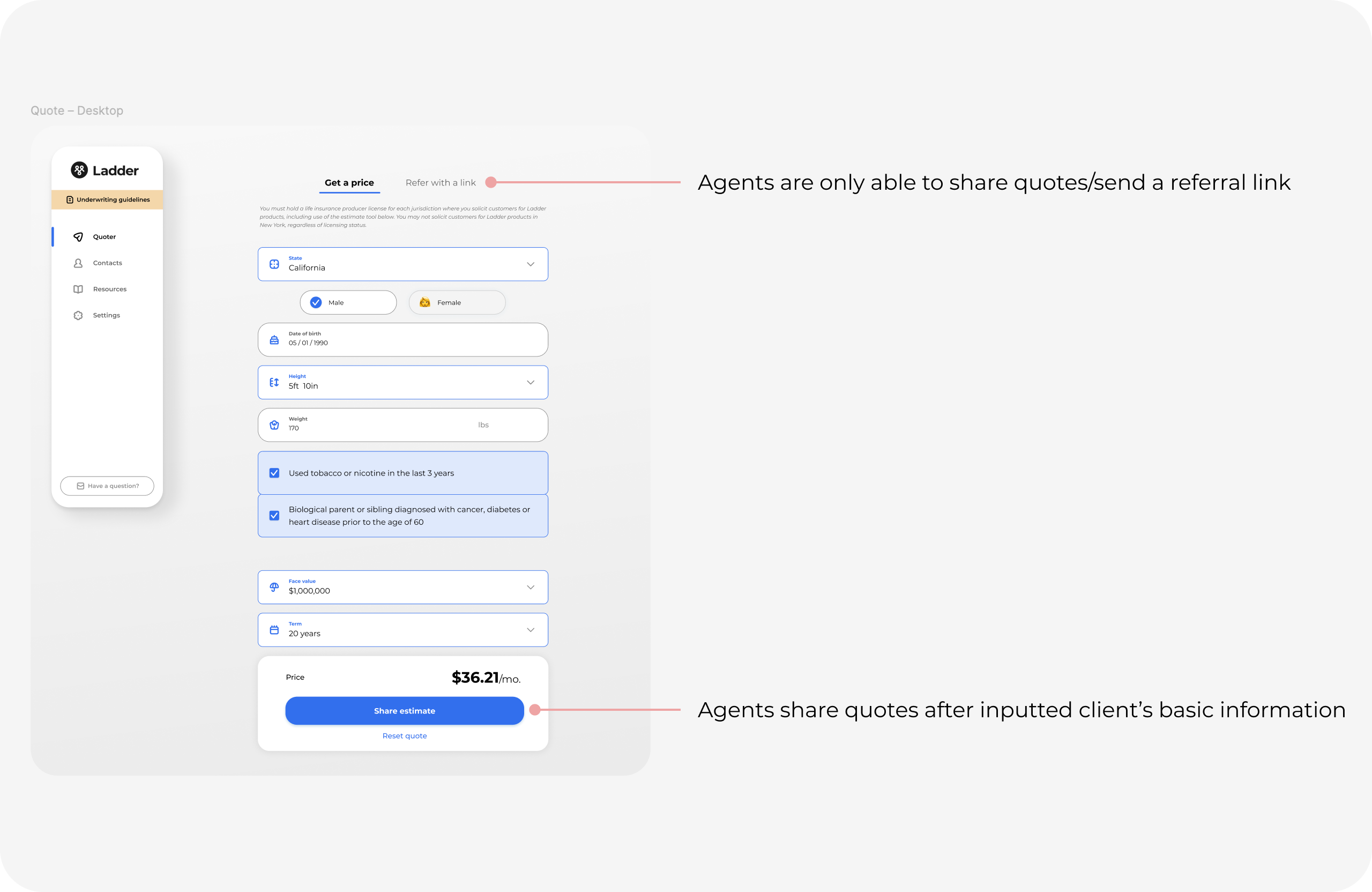
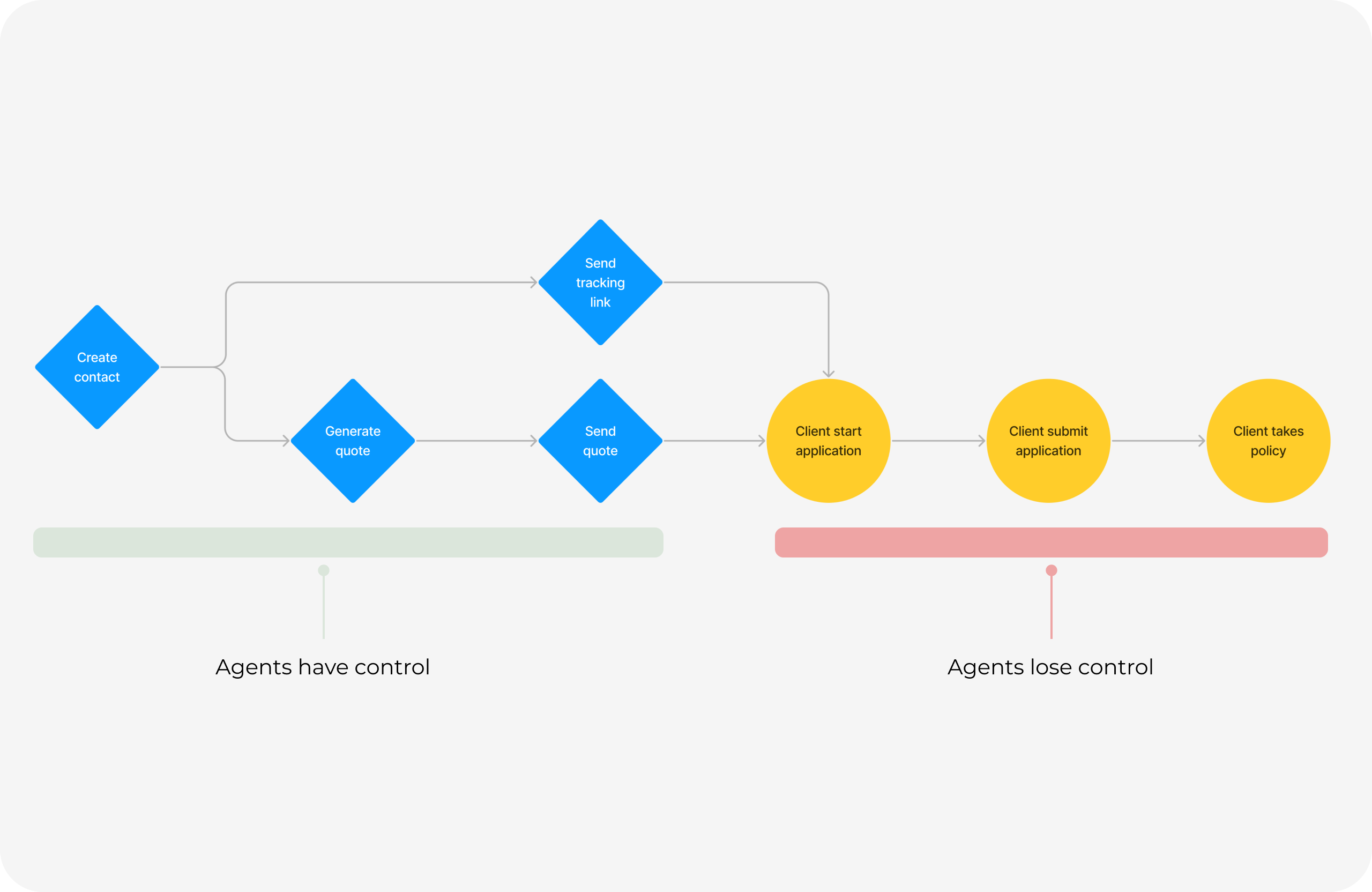
At the time, Ladder only supported referrals and quote sharing for agents.
Once a quote was shared:
- Agents had no control over what happened next
- No visibility into client progress
- No ability to guide, clarify, or close in the moment
- No way to ensure high intent or premium realization
For IMO agents, who are accustomed to closing policies live, this was a deal-breaker.
Agents told us plainly:
"If I can't walk my client through the application, I lose the sale."
Phase 1 - Study & Research
Research & Discovery
To validate the opportunity, I spoke directly with multiple agents across the IMO spectrum.
What we learned
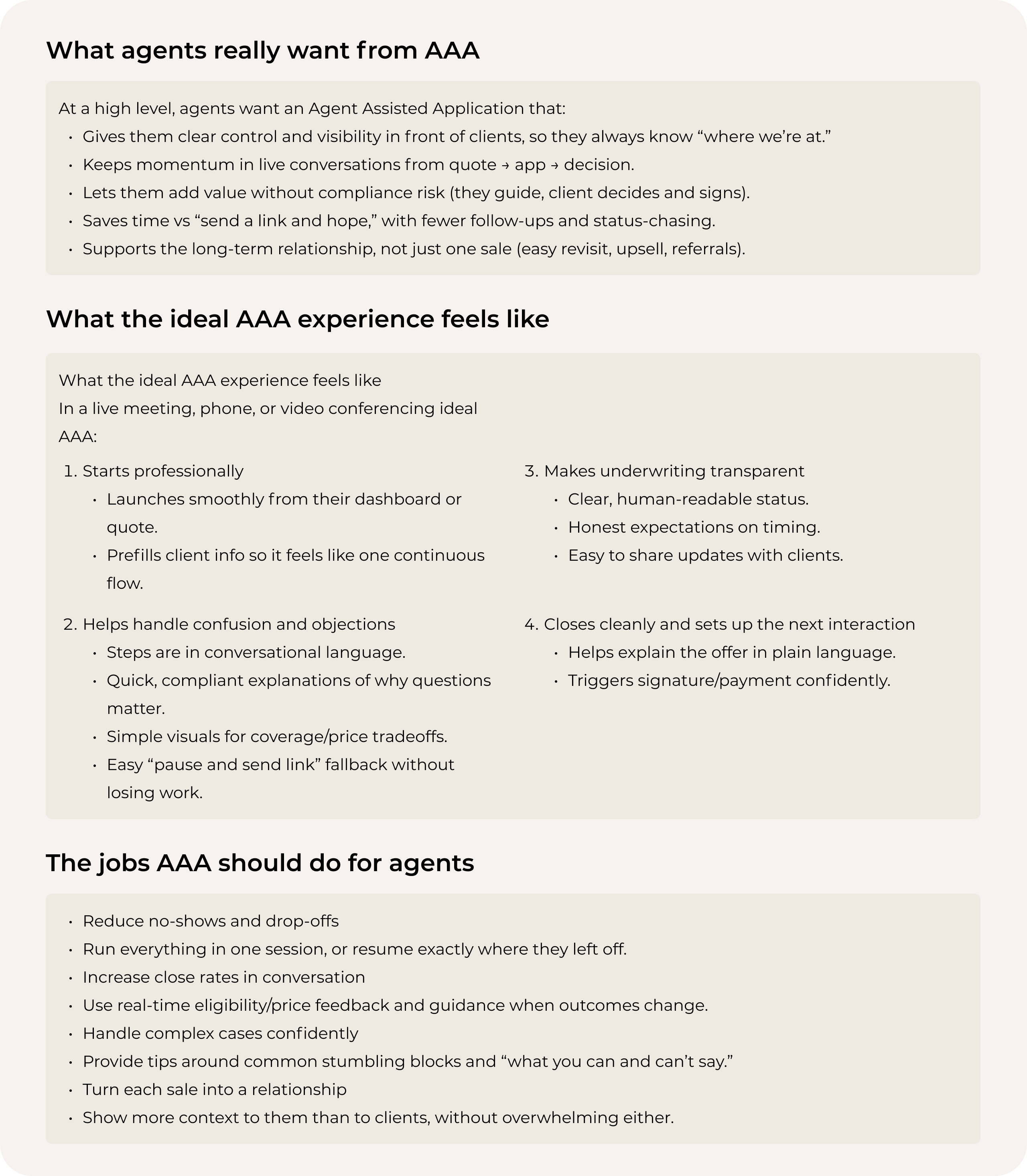
- Some agents appreciated the simplicity of sharing a link
- Many strongly preferred completing the application with their clients
- Agent-assisted flows:
- Ensure higher intent
- Increase confidence at decision points
- Significantly improve bind rates
- Agents saw presence as the difference between a quote and a close
This confirmed that Ladder needed to support both autonomy and control, not just referrals.
Scoping the Opportunity
Rather than treating this as a feature, we framed it as a new distribution capability:
- Unlock IMO-scale growth without building a full agent portal
- Improve bind rates by supporting high-intent, guided applications
- Create a repeatable pattern for future agent partnerships
- Generate a sustainable, recurring revenue channel
The goal wasn't just to help agents. It was to materially improve conversion quality and premium realization.
Phase 2 - Create
Pass-the-Application Flow
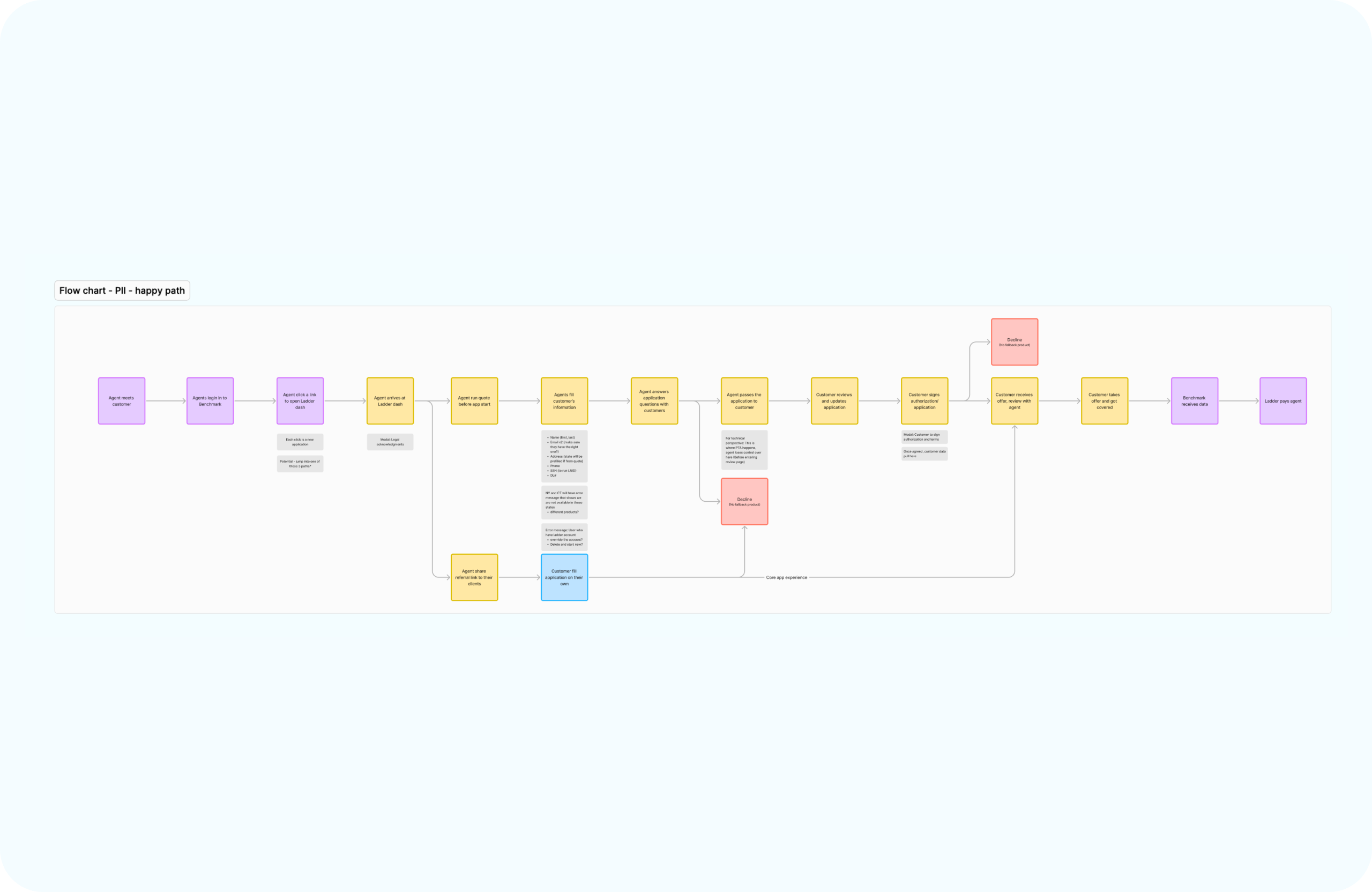
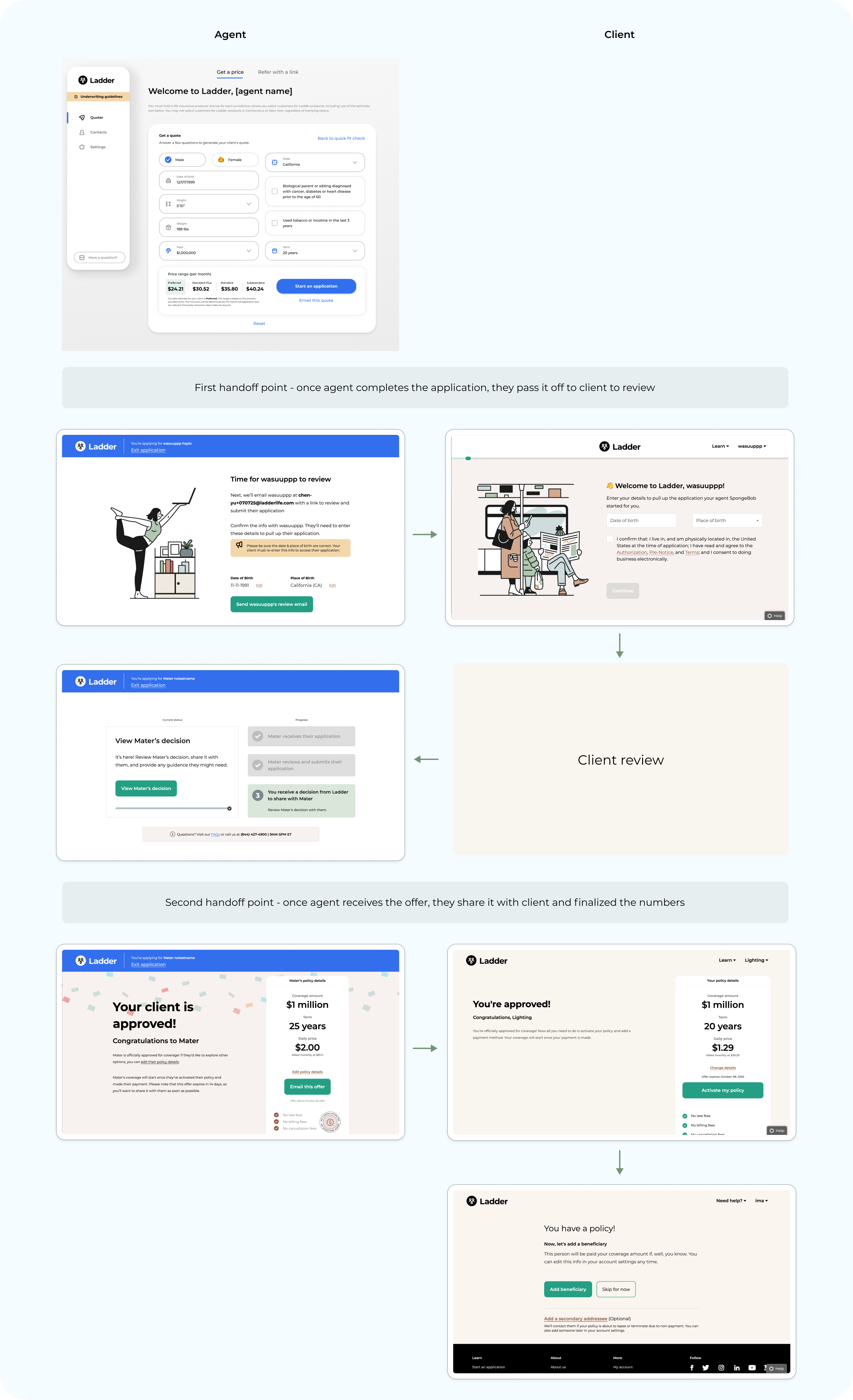
I designed a flexible application model that lets agents:
- Start the application with their client
- Complete high-friction or high-context questions together
- Pass the application to the client for review
- Allow the client to submit confidently, without rework
This balanced agent control with client ownership, reducing drop-off while preserving trust.
Key Design Principles
- Agent presence at high-stakes moments
(health questions, coverage decisions, pricing clarity) - No duplicate effort
Clients never re-enter information already completed with an agent - Clear handoff
Clients understand what the agent completed vs. what they're confirming - Fast time to value
Designed to close policies in-session when possible
Phase 3 - Learn & Impact
Post-launch performance confirmed the strategy:
- 26.9% end-to-end conversion
→ Roughly 1 in 4 agent-assisted clients bind a policy - 65% offer rate
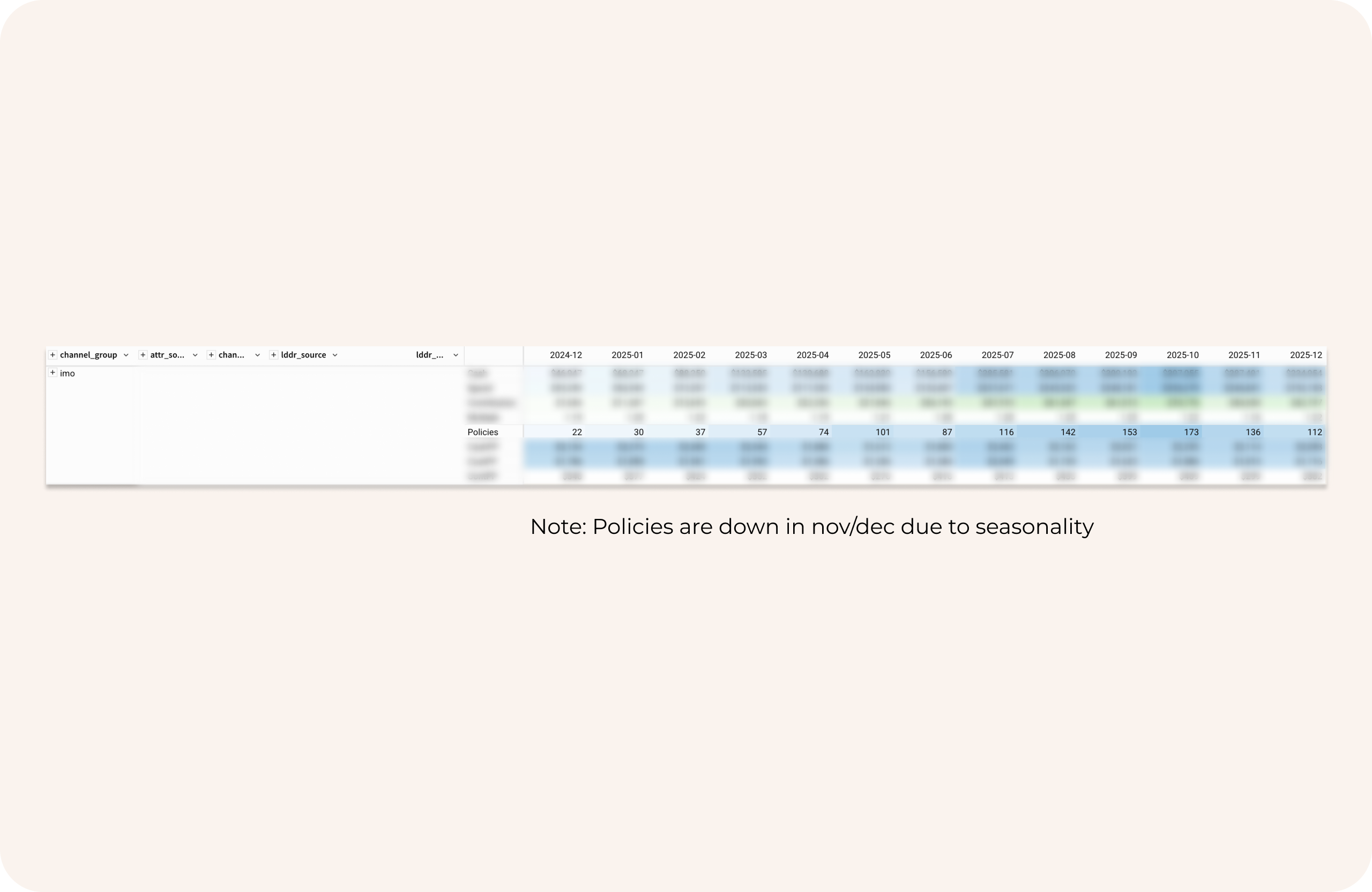
→ With agent guidance, clients are far more likely to qualify successfully - Strong month-over-month growth
→ The IMO channel became a regular, dependable revenue stream
This wasn't just additive volume. It was higher-quality conversion with stronger premium realization.
Reflection & Key Learnings
This project challenged my assumptions about what "good design" means in different contexts. Coming from a D2C background, I initially thought agents would want the same simplicity we built for direct consumers. But agents needed control at the moment of truth, not just a link to share. When they said "if I can't walk my client through this, I lose the sale," that wasn't feedback on a feature. It was feedback on our entire distribution strategy.
Key learnings:
- Distribution goes beyond a channel - it's a fundamental product constraint.
- No amount of optimization can replace understanding how your users actually work.
- The most effective designs align incentives, not just interfaces.
The 26.9% conversion rate validated that approach, but more importantly, it showed that designing for how people actually work unlocks new possibilities.
Next Steps
I'm now extending agent-assisted applications to more products and partners, using this model as a standard for IMO distribution. We're bringing API-driven underwriting into agent flows to enable faster decisions and higher-quality conversion, while leveraging this success to onboard new IMO partners and scale distribution efficiently.
This work laid the foundation for a scalable, multi-partner agent strategy that supports long-term growth without added user friction. By positioning agent enablement as a core growth lever while preserving Ladder's simple D2C experience, we're building a distribution model that works for both agents and direct consumers.